
1.What AI agents do
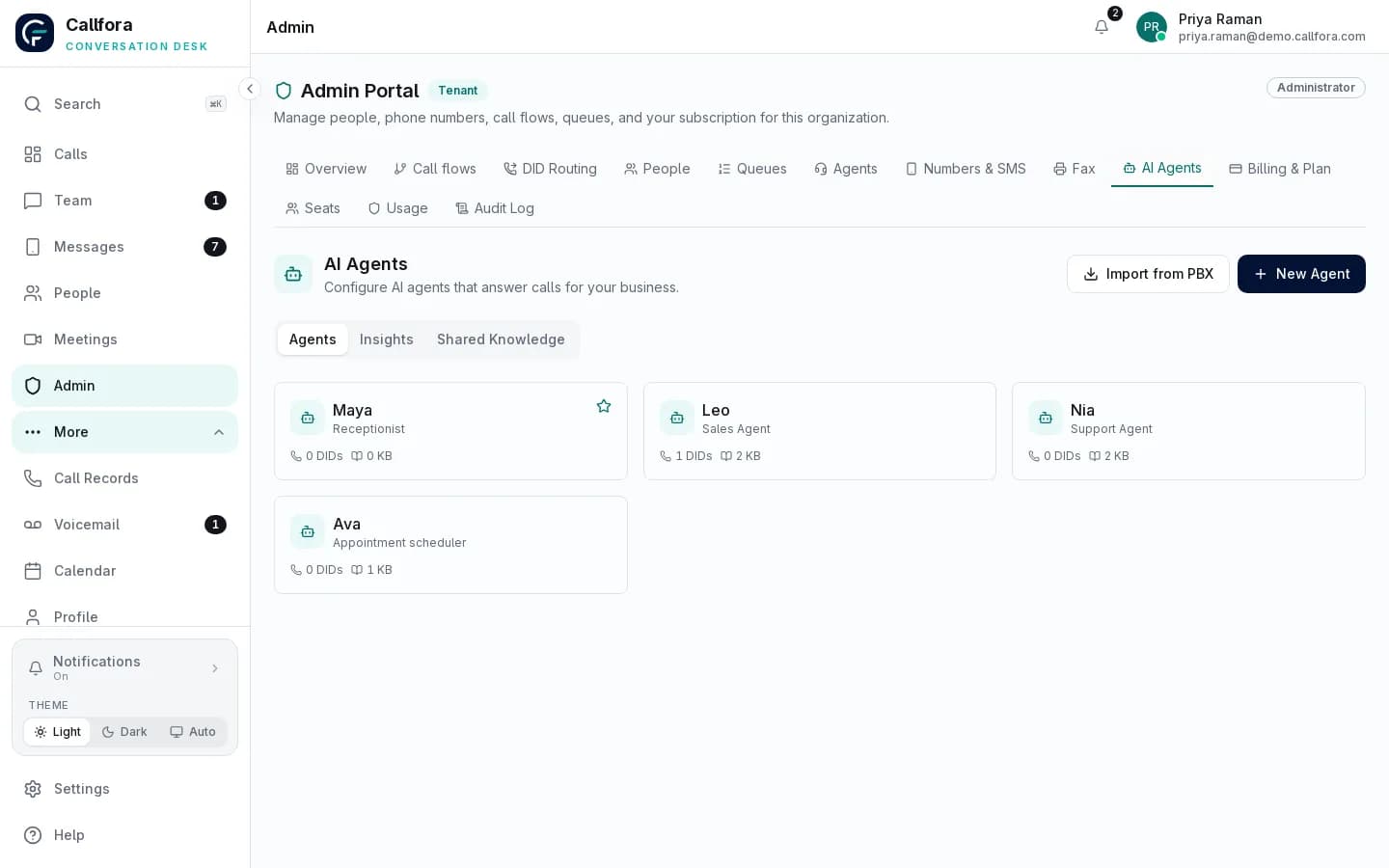
An AI agent can answer calls, ask questions, look up information you provide, book appointments through connected calendars, transfer to people or queues, and write summaries and transcripts. You configure its role, greeting, knowledge, and routing. Agents can also sit in a call-center queue as an extra agent that takes calls alongside people.
AI agents are software. They can misunderstand speech, give wrong or incomplete answers, or fail to connect. Test them and review the results before relying on them.
2.Tell callers they are talking to an AI
You must make sure callers know they are speaking with an AI agent, at the start of the conversation, wherever the law requires it. This is a legal requirement in a growing number of places, including the EU (Article 50 of the AI Act, applying since 2 August 2026) and some US states, and is good practice everywhere. The default greeting for new agents says that the caller is speaking with an AI assistant. Do not remove it for calls that may reach people in these places.
Do not give an AI agent the name, voice, or persona of a real person unless that person has agreed in writing, and do not use it to pretend to be human.
3.Keep humans in charge
- Provide a way to reach a person, such as a transfer to an extension, ring group, or queue, and honour a request for a human.
- Do not use AI agents for decisions that have legal or similarly significant effects on a person, such as credit, insurance, employment, housing, or medical triage, without human review.
- Do not use AI agents for emergency calls or to give medical, legal, or financial advice.
- Set a fallback destination for when the agent cannot help or the service is stopped.
4.Your knowledge and instructions
You are responsible for the instructions, knowledge, websites, and files you give an agent, and for having the right to use them. Do not give it confidential or sensitive data it does not need. The agent may repeat what is in its knowledge to callers.
5.Recording, transcripts, and personal data
AI conversations are processed to produce a response, and audio and transcripts are stored in your workspace so you can review them, subject to your retention settings. Recording and transcription rules apply to AI calls too: see Call recording and monitoring. Voice is personal data and may be biometric data under some laws; do not use AI features to identify people from their voice.
Call analysis is separate from AI agents and is off until a workspace admin switches it on for a queue. It then covers only calls that start after that moment. Each call is transcribed at most once, and the transcript is used for the summary, mood, intent, and quality review. A short or internal call is skipped. Names, phone numbers, and ID or card numbers are masked before a transcript is sent to the language model.
To produce a response, content is sent to the AI processing providers listed on the Subprocessors page. We do not use your content to train our own models. The providers process it under terms that limit how they may use it.
6.AI minutes, limits, and stopping
Plans include a number of AI agent minutes each month. Minutes beyond that are charged per minute, up to an overage limit that the workspace owner sets in the usage page (default zero). When included minutes plus the limit are used, AI agents are stopped: they stop taking calls, are logged out of any queues, and callers are sent to your fallback destination. They restart in the next billing period or when the limit is raised. We also limit the number of agents and simultaneous calls by plan.
7.Restrictions
Do not use AI agents to harass, deceive, or defraud; to collect payment card numbers by voice; to generate spam; to create deepfakes of real people; or to train or benchmark other AI models with the outputs.
8.No warranty for AI output
To the extent the law allows, AI output is provided as is. You are responsible for how you use it and for claims arising from what an AI agent says on your behalf, as set out in the indemnity in the Terms of service.
Need help with this document?
Choose the route that matches your question. These links do not replace the terms above.